 Collection
Collection
Collection
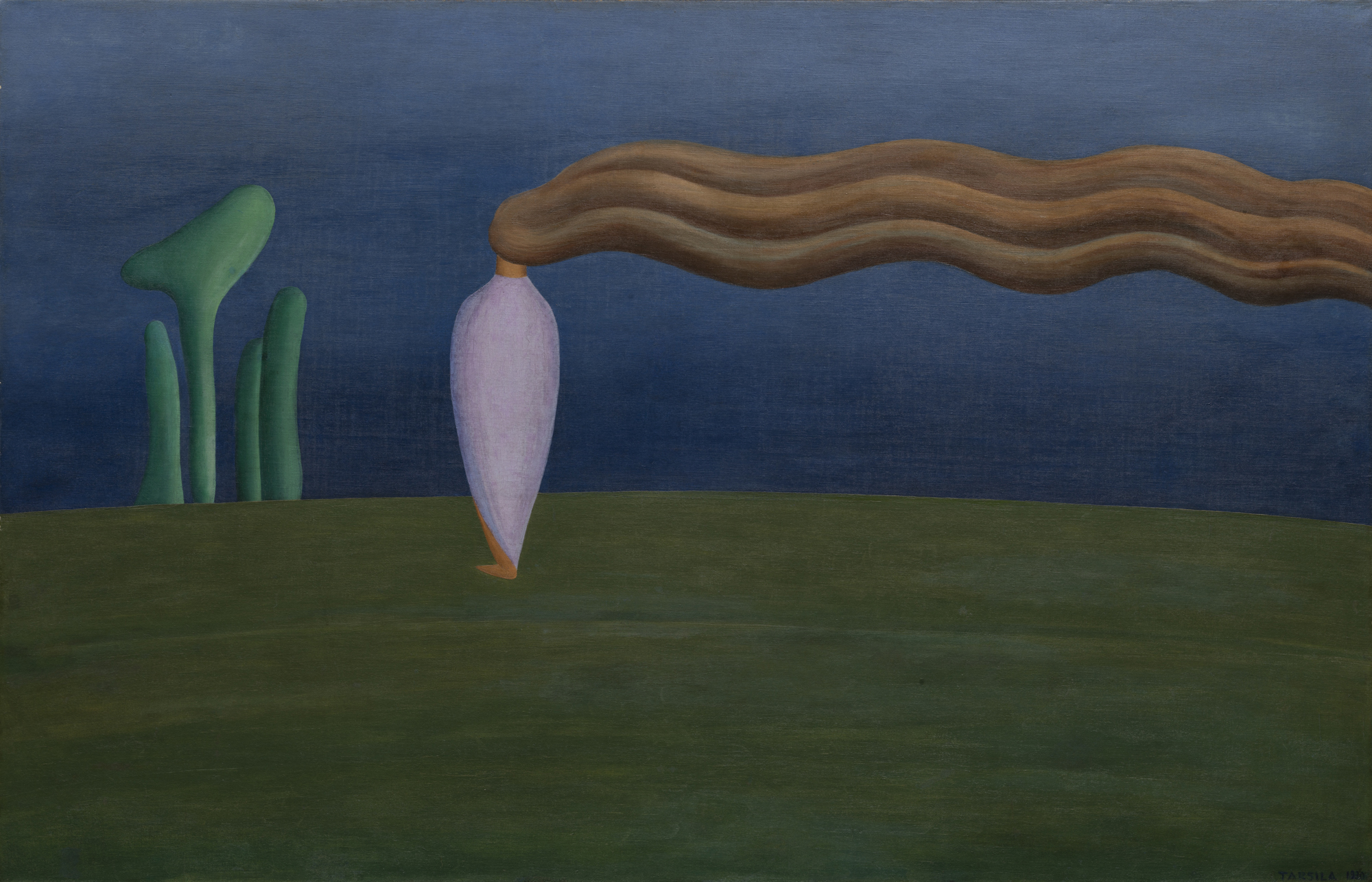


A strong wind sweeps across a solitary female figure in a melancholy nocturnal landscape of olive-green soil and Prussian blue sky. The atmosphere is cold and inhospitable, with the wind blowing the figure’s long, wavy brown hair off the canvas. The figure has her back to the viewer, she is dressed in pink; we do not see her face, but the shape of her body—like a teardrop—suggests her state of mind. She seems to stare into the infinity of the landscape, occupied by four green elements, fantastic vertical vegetation that had already announced itself in previous works. If many works made in 1929 are luminous, radiant, and colorful, this solitary painting done by the artist in 1930 has dark tones. Composição (Figura só) can be considered a self-portrait. 1930 marked an inflection point in the life of the artist, the country, and the world. In 1929, Tarsila’s family of wealthy coffee farmers lost their fortunes in the international financial crisis triggered by the collapse of the New York Stock Exchange in October. In 1930, a coup d’état put an end to Brazil’s Old Republic, plunging the country into the so-called Vargas Era, in reference to Getúlio Vargas (1882–1954), who would govern Brazil until 1945. In the same year, 1930, Tarsila lost her husband and intellectual partner, Oswald de Andrade (1890–1954), who left her for Pagu, the writer Patrícia Rehder Galvão (1910–1962), in a scandal that shocked São Paulo society. Nothing would be as it had been before.
— Adriano Pedrosa, artistic director, MASP, 2019